"Today the
Chelsea Piers are shabby, pathetic reminders of a glorious past.
No ships call there. Decay has set in and is well advanced. Walls
and ceilings are collapsing, windows are shattered, and their
vast empty spaces echo to the rattling and banging of loose sheet
metal, and the creaking timbers, as the winds and tides of the
Hudson exert their changing pressures. The State Department of
Transportation has marked these piers for demolition. The ever-present
threat of fire may turn into a quicker, more merciful, and more
spectacular solution."
These
words were written in the mid-1980's, as preparations were being
made to raze the Chelsea Piers so that a new highway could be built
along the Hudson. But the highway project failed, the Department
of Transportation held an auction, and finally, in 1992, under
the guidance of Roland W. Betts, Tom A. Bernstein and David A.
Tewksbury, the historic waterfront property began its climb back
to fame and fortune.
In
November of 1995, Paul Goldberger of The New York Times wrote:
"The
Chelsea Piers project represents a remarkably well-wrought balance
of public and private priorities, and in an age in which the
purely public development of the waterfront in the form of open
parkland has become an all but unobtainable goal, this project
is as enlightened as we are likely to see. It is a good work
of design, full of a recognition of the potential of this unusual
30-acre site. The place has a presence, a presence that makes
it like no other place in New York."
In
a way, the Chelsea Piers have always been like no other place
in New York.
In
1910, the opening of the Chelsea Piers was marked with a ribbon
cutting and speeches, including lots of back-patting after 30 long
years of talk and 8 years of construction. In 1907, even before
the piers were completed, the first of the new luxury liners, the Lusitania and Mauretania, docked
there. The man responsible for the completion of the piers, Mayor
George B. McClellan, wasn't even in office when the liner Oceanic broke
through a colorful wide ribbon to signal the official opening of
the Chelsea Piers. The next day The New York Times called
them "the most remarkable urban design achievement of their day."
Designed
by the architectural firm of Warren and Wetmore, which
was also designing Grand Central Terminal at the same
time, the Chelsea Piers replaced a hodgepodge of run-down
waterfront structures with a magnificent row of grand
buildings embellished with pink granite facades.
For
the next 50 years, the Chelsea Piers served the needs of the
New York port: first, as the city's premier passenger ship
terminal; then as an embarkation point for soldiers departing
for the battlefields of World Wars I and II; and finally, during
the late 1950s and early 1960s, as a cargo terminal.
After
that, the Chelsea Piers, like much of Manhattan's waterfront,
became neglected maritime relics, made obsolete by the jet
plane that whisked passengers across the Atlantic and the large
container ships that required dock facilities and truck linkages
that Manhattan could never provide.
The
redevelopment of the four surviving Chelsea Piers marks a major
step in the rebirth of the Manhattan waterfront for public
use and recreation, and returns these piers to the prominence
they enjoyed during the early 20th Century when they were the
center of international ocean liner travel.
*
* * * *
In
the early days, as docks for the famed White Star
and Cunard lines, the Chelsea Piers welcomed most of the world's
great
liners. Sometimes, in the afternoons, one could
see as many as twenty stacks, as five liners prepared to sail on
the evening
tide.
At
the same time that the rich and famous were arriving at the
Chelsea Piers, so were the immigrants, many of whom traveled
in steerage class and suffered extreme hardships, including
incredible overcrowding and disease. New York City was the
port of entry preferred by shipping lines for discharging their
immigrant cargoes. By 1910, thousands of immigrants were arriving
at the Hudson River shoreline everyday. Most ships came first
to the Chelsea Piers, where the travelers were transferred
to ferries for the final leg of their journey to Ellis Island
and freedom.
Occasionally
a menacing note intruded. The Titanic was
scheduled to arrive at the Chelsea Piers on April 16, 1912,
at the conclusion of her maiden voyage. Fate intervened,
and the "unsinkable" ship struck an iceberg and sank on April
14, 1912. Of the 2200 passengers aboard, 675 were rescued
by the Cunard liner Carpathia , which arrived
at the Chelsea Piers on April 20th.
In
May 1915, the luxury liner Lusitania departed
from the Chelsea Piers on her regular run to England. Off
the coast of Ireland, she was torpedoed by a German U-boat,
killing 1,198 people, including 124 Americans. This event
mobilized public opinion in support of America's entry into
World War I.
For
the duration of the war, the Chelsea Piers, like the docks
in great harbors everywhere, were busy participants in the
war effort. As the twenties unfolded, a new prosperity came
to the land and celebrities flocked to the Chelsea Piers to
be photographed and interviewed, leaving for, or returning
from, Europe in grand style. Then came October 29, 1929, and
the fateful stock market crash. Cunard's Barengaria was
the first ship to dock at Chelsea Piers a few days afterward
to throngs of reporters who chronicled the fact that all but
a handful of passengers debarked bankrupt.
By
1933, the economic tide for the Chelsea-based fleet had changed.
The Depression had wreaked havoc upon transatlantic travel,
and the Atlantic trade dropped from one million voyagers in
1929 to fewer than half by 1935. The thirties, meanwhile, brought
another development to the Chelsea Piers. Huge new vessels
like the 1,000-foot Normandie and Queen Mary came
steaming into port, sweeping the Chelsea Piers into the past.
New and much longer piers were needed and then constructed
between West 44th and West 52nd Streets, forming what we still
call "Luxury Liner Row."
The
high point of the decade was the departure in July 1936
of the United States Olympic team from the Chelsea Piers
to the site of the Games in Berlin, Germany. At those
Games, Jesse Owens became the hero of the American people
by winning four gold medals in track. His return to the
Chelsea Piers was marked by great excitement and huge
crowds.
The
Chelsea Piers had a brief resurgence as a major embarkation
point for troop carriers that took American servicemen to the
European theater in World War II, but afterwards, never regained
their former importance for passenger shipping. Then in 1958,
nearly all transatlantic passenger ship travel came to a halt,
when daily commercial jet service to Europe began. After that,
the piers were used almost exclusively for cargo handling until
1967, when the last big tenants, the Grace and United States
lines, relocated to New Jersey. Chelsea Piers' shipping days
were over.
In
1976, the glorious OpSail awakened citizens to the possibility
of recreational waterfront redevelopment. Finally, the waterfront
was regarded as a historic resource worthy of being preserved.
But still the Chelsea Piers were scheduled for demolition to
make way for the Westway Plan. Owned by the New York State
Department of Transportation, the Chelsea Piers at the time
were a nasty combination of various warehouse and parking uses.
Pier 60 was the New York City Tow Pound; Pier 59, a repair
shop for sanitation trucks; and Pier 62, a U.S. Customs Impound
Station. There were plenty of broken-down fences, crumbling
walls...and distant memories of glittering gowns and soft
music...
...but
the Chelsea Piers just sat there rusting in
the harbor air
until destiny called them back.
In
May 1992, after six months of comprehensive research and the
preparation of a detailed proposal, a newly-formed company,
Chelsea Piers Management, Inc., submitted a bid and proposal,
as part of a public auction process, to the New York State
Department of Transportation to obtain rights to develop and
operate the Chelsea Piers. Shortly thereafter, Chelsea Piers
Management was awarded the rights to lease the Chelsea Piers
and to develop and operate a sports and entertainment facility
on the premises. After Chelsea Piers Management was awarded
the lease, an experienced development and construction team
was assembled, and a 24-month, intensive design and program
planning process began. Some 20 different federal, state and
city agencies reviewed and approved the project. In May 1994,
the final building permits were granted.
Start
of construction was celebrated at Groundbreaking Ceremonies
held at Chelsea Piers on July 12, 1994, attended by New York
Governor Mario M. Cuomo, New York City Mayor Rudolph W. Giuliani,
Manhattan Borough President Ruth W. Messinger, other political,
sports and entertainment industry dignitaries, and over 1,200
invited guests.
Beginning
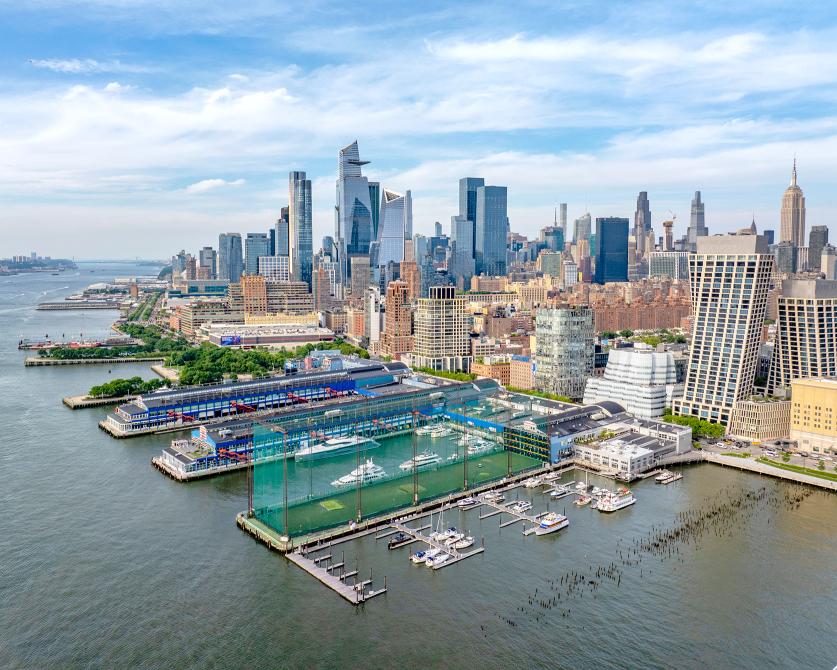
in August 1995, Chelsea Piers Sports and Entertainment Complex
opened in stages. Situated on Piers 59 through 62, and in the
connecting headhouse, the Complex features:
The
Golf Club, The Sports
Center health club, Chelsea Piers Bluestreak, Sky Rink, The Field House, The
Spa at Chelsea Piers, MarineMax Surfside 3 Maritime
Center,
and more.
This
$100 million, privately-financed project has transformed the
historic, but long-neglected, Chelsea Piers into a major center
for public recreation and waterfront access.
And
sometimes on clear, bright evenings, you can still hear the
laughter of bygone days floating gently on the breeze as it
passes through the reborn Chelsea Piers.